
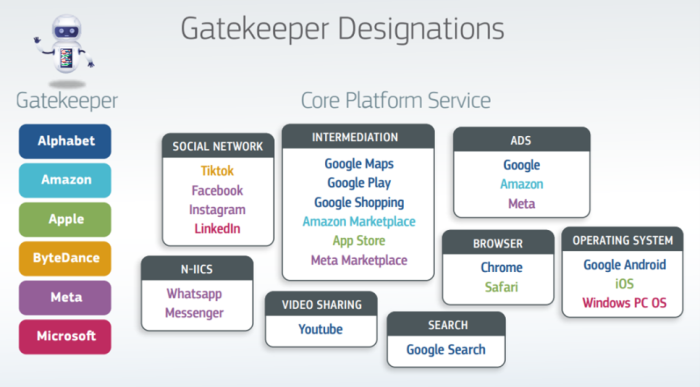
On 6 September 2023, the European Commission designated six large online platforms as the first “gatekeepers” under the Digital Markets Act (“DMA”)[1], namely Alphabet, Amazon, Apple, ByteDance, Meta and Microsoft. Gatekeepers will face stricter rules regarding their daily operations. In particular, 22 core platform services provided by these undertakings have been designated:
Alphabet: Android, Google Search, Chrome, Google Maps, Google Play, Google Shopping, Google Ads and YouTube,
Amazon: Amazon Marketplace, Amazon Ads,
Apple: App Store, Safari, iOS,
ByteDance: TikTok,
Meta: Facebook, Instagram, WhatsApp, Messenger, Meta Marketplace, Meta Ads, and
Microsoft: LinkedIn, Windows PC OS.
Regulatory Framework
The DMA, which entered into force on 1 November 2022, aims at preventing “gatekeepers” from imposing unfair conditions on end or business users and ensuring data privacy. Under the DMA, the European Commission can designate digital platforms as “gatekeepers”, if they provide an important gateway between businesses and consumers in relation to core platform services.
Which undertakings can be designated as “gatekeepers”?
- substantive criterion
Only undertakings that provide at least one of the core platform services can be designated as “gatekeepers”. These core platform services include, inter alia, online intermediation services such as app stores, online search engines, online social networking services, certain messaging services, video sharing platform services, virtual assistants, web browsers, cloud computing services, operating systems, online marketplaces, and advertising services.
- quantitative criteria
There are three quantitative criteria that create the presumption that an undertaking is a “gatekeeper”.
- the undertaking achieves annually a turnover of at least EUR 7,5 billion in each of the last three financial years and provides a core platform service in at least three EU Member States,
- the undertaking provides a core platform service to at least 45 million monthly active end users established or located in the EU and at least 10,000 yearly active business users both established in the EU, and
- the undertaking met the second criterion during the last three years.
Obligations for “gatekeepers”
“Gatekeepers” bear additional responsibilities due to their increased market power and the significant position they hold. In particular, gatekeepers must, among others:
- refrain from certain actions relating to the process, combination and cross-use of personal data collected by users, absent of an explicit consent by the latter as to tracking and use of them,
- not impede business users from offering or promoting their products or services through online intermediation services and core platforms other than those of the gatekeepers,
- allow and technically enable users to easily install, amend, unsubscribe and un-install software applications originating either from the former or third parties,
- not treat less favorably in ranking or discriminate against services or products that are offered by a third party and not by the “gatekeeper”, and
- inform the European Commission of any intended concentration.
The designations of the undertakings as “gatekeepers” will be reviewed at least every three years by the European Commission, to determine whether these continue to satisfy the aforementioned criteria.
Next steps
The “gatekeepers” have six months to comply with the aforementioned obligations (with the exception of the latter obligation which is effective immediately). To that end, the “gatekeepers” should within six months submit to the European Commission a detailed compliance report in which they report their measures to comply with each of the obligations under the DMA. The European Commission is also entitled to ensure effective compliance and has the power to impose significant fines in case of an infringement.
Lastly, the Commission is further empowered to carry out market investigations to determine whether other undertakings providing core platforms services may also qualify as “gatekeepers”, as well as to update the obligations for “gatekeepers” when necessary and to design tailored remedies for infringements of the DMA rules.
[1] Regulation (EU) 2022/1925 of the European Parliament and of the Council of 14 September 2022 on contestable and fair markets in the digital sector and amending Directives (EU) 2019/1937 and (EU) 2020/1828 (Digital Markets Act), OJ L 265, 12.10.2022, p. 1–66.